
• Skip to primary navigation
  • Skip to main content
Allure Clinic Porto

Allure Clinic Porto

Allure Clinic - Vascular Surgery, Endocrinology, Nutrition, Aesthetic and Dermatological Treatments Clinic

X

Search

+351 227 664 982 or +351 227 662 751 (call to the national fixed network)
  • Português

MENU

X

  • Start
  • Leg Clinic® by Allure
  • Specialties
    • Vascular Surgery
    • Excessive sweating
    • Plastic Surgery and Aesthetic Medicine
    • Endocrinology
    • Nutrition
    • Dermatology
    • Lipedema
    • Cellulite and sagging
    • Physiotherapy
  • Allure Clinic
    • Clinic
      • About Allure Clinic
      • Allure Clinic Team
      • Scientific Articles
    • Specialist Doctors
      • Dr. Joana de Carvalho
      • Prof. Doctor Sergio Sampaio
      • Dr. Ana Isabel Moreira
      • Dr. Carolina Andresen
      • Dr. Eduardo Lima da Costa
      • Dr. José Carlos Vidoedo
      • Dr. Margaret Lion
      • Dr. Selma Souto
      • Dr. Rosa Dantas
      • Dr. Filipa Jácome
      • Dr. Larissa Lanzaro
      • Dr Leonor Vasconcelos
      • Dr Tiago Soares
    • Nutritionists
      • Dr. Barbara Nogueira
      • Dr. Carmen Fortes
      • Prof. Doctor Inês Tomada
    • Physiotherapist
      • Dr. Marianna Lou
      • Dr. Beatriz Barbosa
      • Dr Tatiana Carrasco
    • Physiologist
      • Dr. Tiago Pereira
  • Contact us
  • Book Consultation
  • Specialties
    • Leg Clinic - by Allure - Vascular Surgery Porto

      Leg Clinic® by Allure

      Vascular Surgery

      Vascular Surgery

      Excessive sweating

      Excessive sweating

      Plastic Surgery and Aesthetic Medicine

      Plastic Surgery and Aesthetic Medicine

      Dermatology

      Dermatology

      Nutrition

      Nutrition

      Endocrinology Porto

      Endocrinology

      Accent Prime

      Localized Fat, Cellulite and Sagging

  • Leg Clinic® by Allure
  • Allure Clinic
    • Clinic

      Clinic

      About Allure Clinic

      Allure Clinic Team

      Scientific Articles

      Specialist doctors and nutritionists at Allure Clinic in Porto

      Allure Team

      Dr. Joana de Carvalho

      Prof. Doctor Sergio Sampaio

      Dr. Ana Isabel Moreira

      Dr. Carolina Andresen

      Dr. Eduardo Lima da Costa

      Dr. José Carlos Vidoedo

      Dr. Selma Souto

      Dr. Rosa Dantas

      Dr. Filipa Jácome

      Dr. Larissa Lanzaro

      Dr Leonor Vasconcelos

      Dr. Barbara Nogueira

      Dr. Carmen Fortes

      Dr. Marianna Lou

      Dr. Tiago Pereira

      Prof. Doctor Inês Tomada

      Dr Tatiana Carrasco

      Dr Tiago Soares

  • Contact us
  • Book Consultation
  • Start
  • Endocrinology
  • Vascular Surgery
  • Excessive sweating
  • Aesthetic Medicine
  • Dermatology
  • Clinical Cases

When can a skin mole be removed and what are the treatments?

Everyone has some distinguishable marks on their skin, known as moles.

Most of them may be harmless lesions, but what is certain is that sometimes they need to be removed.

But how can we differentiate between normal signs and potentially dangerous ones that need to be eliminated?

That's what we're going to find out, as well as the best way to remove moles or tumors.


What are the different types of signals?

The signs arise from the cells that produce melanin, responsible for the skin pigmentation process – melanocytes.

Some are born with us, others appear throughout life in any part of the body.

In addition to genetic causes, which can increase the predisposition to the appearance of these marks, exposure to ultraviolet rays can also lead to the formation of new lesions.

Furthermore, they can vary in shape or tone: darker or lighter, voluminous or flat, round, oval or other shapes.

As you can see, there are many types of signs. But the main characteristic that can distinguish them is their benign or malignant nature.


Why remove Signs?

Some of these lesions may remain the same, but others may develop into tumors.

In fact, in Europe, a percentage of skin cancers are melanomas, which evolve precisely from a malignant mole, according to the Portuguese Skin Cancer Association.

Like this, These marks can be removed if they prove to be potentially dangerous, after a dermatological evaluation.

On the other hand, even if they are benign, You can remove them if they are uncomfortable or for aesthetic reasons, especially if they are signs on the face.


Find out more and book your appointment


How do I know if a Sign needs to be removed?

We already know that a mole can be removed if there's a chance it could be malignant. But how do we assess this risk?

Through a simple rule, that of ABCDE. As a rule, a sign can represent danger according to the following characteristics:

  • Asymmetry (A): comparing the two halves of the signal, one is different from the other;
  • Board (B): the edges are poorly defined or irregular;
  • Color (C): variable and non-uniform tones, which can vary between brown, bluish, gray or black;
  • Diameter (D): greater than 6 mm;
  • Evolution (E): recent changes, particularly regarding size, color or thickness, for example.
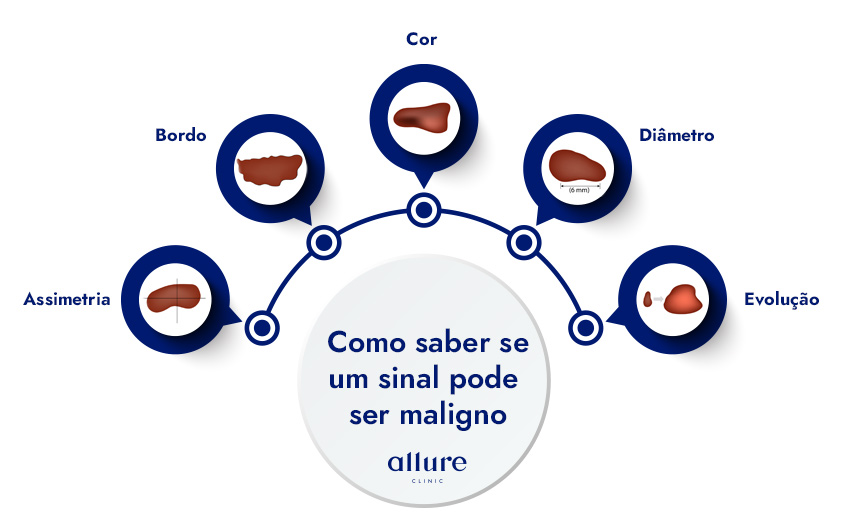
 

It is essential that this analysis is carried out by the patient himself, through a recurring and thorough self-examination, paying attention to any changes in existing signs, the appearance of new lesions or wounds that do not heal.

During observation, it is important not to forget the less visible parts, namely between the fingers, on the scalp, behind the ears and armpits, for example.

If you recognize some of the aspects that make a mole potentially dangerous in your own marks, or if there happens to be itching or bleeding, You should consult a dermatologist as soon as possible for an evaluation.


What are the procedures for removing Signs?

Nowadays, it is relatively easy and quick to remove moles.

Although there are other techniques considered in some cases, such as laser therapy, the usual practice is to resort to a surgical method, which not only eliminates the problem definitively but also allows the lesion to be studied histologically through exams to diagnose its benign or malignant nature.

Removal is done by excision, and it is then necessary to suture the site of the intervention.

Although it is a surgical technique, it is performed safely in the office, using local anesthesia.


After removal

Since stitches are required, which are removed after a few days, there is always the possibility possibility of a scar forming.

This is an important consideration, especially for those who choose to remove a mole for aesthetic reasons. After all, no one wants to remove an annoying mark and, in the process, get another.

In addition to the professional's technique and experience, which contributes to making the scar as imperceptible as possible, post-treatment care is also essential, particularly regarding hydration of the area in question.

This way, you don't have to worry: the appearance tends to improve over time.

Furthermore, it is also important to disinfect the area being operated on, reducing the risk of possible infection after any surgery.


Find out more and book your appointment


Want to know how you can protect your health?

If there were a secret to safeguarding your health from the presence of warning signs, it would be knowing how to identify warning signs.

But that's not all: as each patient has their own pattern and characteristics, a specialist is the best person to evaluate them, to avoid the risk of developing more serious diseases, such as tumors.

If you are looking for a dermatologist to remove moles or for advice on your situation, Allure Clinic has several spaces, namely in Porto.

The commitment: to minimize risks and achieve effective results, as close as possible to what was expected.

When can a skin mole be removed and what are the treatments?

Dr. Ana Isabel Moreira

  • Aesthetic Dermatologist
  • Graduated from the Faculty of Medicine of the University of Porto
  • Specialist in Dermatology and Venereology
  • Reviewer of scientific articles at the invitation of international journals
  • Member of the Portuguese Society of Aesthetic Medicine (SPME)
See Full Biography

Related Articles

Dermatology

Psoriasis: the different types of the disease

Read more

Dermatology

What to consider when choosing a dermatology clinic

Read more

Dermatology

Learn all about facial peeling

Read more

Dermatology

Pendulum Fibroma: What it is, how to distinguish it from a mole and what the treatment is

Read more

Dermatology

Clinical Case of Rosacea Treatment with IPL

Read more

Dermatology

Clinical Case of Melasma Treatment with IPL

Read more

Dermatology

How to Protect Your Hands from Frequent Washing?

Read more

Learn more about treatments or book an appointment


    Please read and accept the Privacy Policy.

    Allure Clinic

    Allure Clinic is a vascular surgery, dermatology, plastic surgery, aesthetic medicine, nutrition, and endocrinology clinic located in downtown Porto. This clinic uses cutting-edge technology to ensure optimal results with minimal invasiveness.

    The team is made up of specialist doctors, nutritionists, a dermatofunctional physiotherapist, and auxiliary professionals whose main mission is to provide genuine, integrated, and personalized care to each patient.

    Harbour - 4th floor
    ERS Registration No.: E177314
    Operating licence 25737/2025

    Harbour - 6th floor
    ERS Registration No.: E152012
    Operating Licence No.: 20079/2021


    Allure Porto

    +351 227 664 982 or +351 227 662 751
    (call to the national fixed network)

    +351 964 282 606
    (call to the national mobile network)

    Porto Address

    Boavista Avenue, No. 117 Floor 4, room 406 Floor 6, room 605 4050-115, Porto

    contactos@allureclinic.pt

    Leg Clinic Lisbon

    +351 217 938 672
    (call to the national fixed network)

    +351 926 858 796
    (call to the national mobile network)

    Address Lisbon

    Campo Grande 283ºF 1700-093 Lisbon

    lisboa@allureclinic.pt

    Useful Links

    • Privacy Policy
    • Cookie Policy
    • Site Map
    • Blog

    Follow us

    Allure Clinic

    Allure Clinic - Porto

    © 2026, Allure Clinic - All rights reserved.

    We've detected you might be speaking a different language. Do you want to change to:
    Change language to Português Português
    Change language to Português Português
    English (UK)
    Change Language
    Close and do not switch language
    Manage Consent
    To provide the best experiences, we use technologies such as cookies to store and/or access device information. Consenting to these technologies will allow us to process data, such as browsing behavior or unique IDs on this website. Not consenting or withdrawing consent may negatively affect certain features and functions.
    Functional Always active
    Storage or technical access is strictly necessary for the legitimate purpose of enabling the use of a particular service expressly requested by the subscriber or user, or for the sole purpose of transmitting a communication over an electronic communications network.
    Preferences
    Storage or technical access is necessary for the legitimate purpose of storing preferences not requested by the subscriber or user.
    Statistics
    Technical storage or access that is used exclusively for statistical purposes. Technical storage or access used solely for anonymous statistical purposes. Without a subpoena, voluntary compliance from your Internet Service Provider, or additional third-party records, information stored or retrieved solely for this purpose generally cannot be used to identify you.
    Marketing
    Storage or technical access is necessary to create user profiles to send advertising or to track the user on a website or across multiple websites for similar marketing purposes.
    • Manage options
    • Manage services
    • Manage {vendor_count} vendors
    • Read more about these purposes
    View preferences
    • {title}
    • {title}
    • {title}
    X
    Need help?
    1
    Whatsapp Allure Clinic
    Hello! How can we help you?
    (We are available every weekday from 10:00 to 19:00)
    Contact us