

Pendulum Fibroma: What it is, how to distinguish it from a mole and what the treatment is
What is Pendulum Fibroma?
Pendulum fibroma, or soft fibroma, is a very common epidermal proliferation.
Over the course of their lives, almost everyone develops pendulous fibromas. These are small skin projections that typically develop in the cervical region, armpits, and/or groin.
These fibromas are frequent lesions that are completely benign, without any risk to the patient's health.
Patients seek treatment for this dermatological condition not because it is serious, but because it causes discomfort in their daily lives and is sometimes unsightly.
However, occasionally, Patients end up traumatizing the lesions and causing bleeding. This can happen after pulling a thread on the neck or after waxing.Naturally, when this happens, there is increased concern and they end up seeking medical help from a Dermatologist.
Why do Soft Fibromas appear?
There are people who are more predisposed to developing this problem.
It is usually a sporadic lesion, but appears more frequently in people who are obese, diabetic or, in some way, glucose intolerant.
These risk groups begin to develop pendulous fibroids early on, eventually developing a high number of lesions that cause great discomfort.
Learn more about:
How to distinguish a pendulous fibroma from a mole?
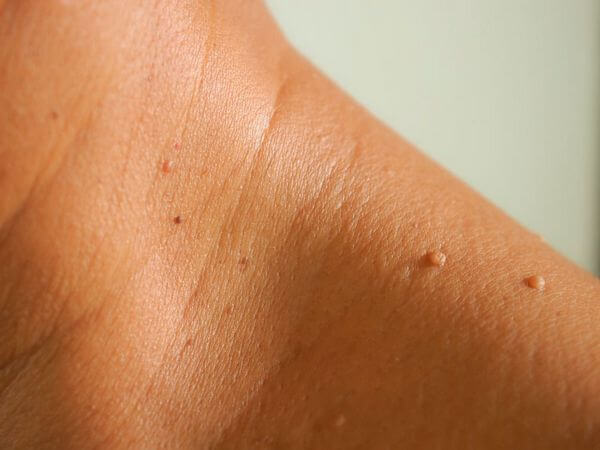
Pendulum fibromas are small, skin-colored, pedunculated projections.
If they are reddish in color, they may be angiomas or other types of lesions.
If they are brownish in color, they may be moles, as there are also pedunculated and raised moles that can mimic soft fibromas. If clinically they appear to be a mole, even if benign, their excision should be followed by a histological examination.
Naturally, a diagnosis made by a Dermatologist is always necessary so that it can be treated appropriately.
What is the Treatment for a Pendulum Fibroma?
Since this is a benign lesion, the most common dermatological technique is the cutting technique.
It's a simple, in-office procedure that doesn't require stitches. Anesthesia is rarely required, and a laser or scalpel is used to cut the fibroid at the base, automatically coagulating it.
Depending on the number of lesions, treatment can take between 10 and 15 minutes. If the patient has dozens of pendulous fibroids, the procedure takes longer.
In the following days, the lesions will develop a small scab, which the patient should disinfect. The scabs should fall off naturally to avoid leaving any scars or marks.
Learn more about:
Frequently Asked Questions about Pendulum Fibroid Treatment
Is pendulum fibroma treatment painful?
Since local anesthesia is usually used, the treatment is painless.
Is the procedure quick?
The duration depends on the number of lesions. If the patient has many lesions, the procedure takes longer. If the patient has few lesions, it's a very quick procedure.
What is recovery from treatment like?
Since this is a procedure that does not involve stitches in the skin, the patient does not need any downtime and can go to work immediately.
What precautions should you take?
While you're in the recovery phase, you shouldn't expose the treated area to the sun. You should disinfect it with a disinfectant prescribed by your doctor, and you shouldn't remove the scabs at any time. After the scab falls off, you should apply an emollient cream regularly to help the skin recover as quickly as possible.
How long does it take for the injury to heal?
Healing time varies depending on each person's characteristics. Generally, after 10 days, the scab has fallen off and the problem is resolved.
Is there a possibility of recurrence after treatment?
Treatment is permanent. However, if there is a predisposition to developing these lesions, we cannot guarantee that new lesions will not appear in the same area over time.

Dr. Ana Isabel Moreira
- Aesthetic Dermatologist
- Graduated from the Faculty of Medicine of the University of Porto
- Specialist in Dermatology and Venereology
- Reviewer of scientific articles at the invitation of international journals
- Member of the Portuguese Society of Aesthetic Medicine (SPME)
 English (UK)