

Compensatory Hyperhidrosis – What is it and what is the associated cause?
Excessive sweating, when independent of physical exercise or high temperatures, can cause discomfort and social embarrassment.
The truth is that hyperhidrosis, the name given to the disease of excessive sweating that affects more than 500,000 Portuguese people, has seen a light at the end of the tunnel when it comes to available treatments, but some of these treatments may have an associated risk: compensatory hyperhidrosis (that is, sweating profusely in other areas of the body).
Treatments for Hyperhidrosis
Depending on the type of hyperhidrosis and the affected area, your doctor may suggest several procedures, including:
- Topical Treatments (applied locally to the skin);
- Oral Medication;
- Regular Toxin Injections;
- MiraDry®;
- PalmaDry (Iontophoresis);
- Endoscopic Thoracic Sympathectomy.
Topical Treatments
Antiperspirants containing aluminum chloride or creams containing glycopyrrolate may be suggested, which aim to block sweat production and inhibit the activation of sweat glands.
- There is no risk of compensatory hyperhidrosis.
Oral Medication
There are medications that block the transmission of nerve impulses (i.e., they block the "order to sweat"). In these cases, this medication can reduce sweat production.
- There is no risk of compensatory hyperhidrosis.
Regular Toxin Injections
To the regular injections with toxin They are an excellent way to temporarily combat axillary, palmar, and other body hyperhidrosis by treating the specific areas where they are applied. What happens in this case is the blocking of neurotransmission from sympathetic nerves to the sweat glands, thus reducing excessive sweating.
- There is no risk of compensatory hyperhidrosis in most cases (and when this occurs, it is only temporary and to a minor degree).
MiraDry®
THE MiraDry® It's a specific procedure to eliminate excessive sweating, or bromhidrosis, in the armpits. It uses electromagnetic energy to dissolve the sweat glands and provides immediate and permanent results.
- There is no risk of compensatory hyperhidrosis.
PalmaDry (Iontophoresis)
THE PalmaDry, based on iontophoresis, is an effective treatment for reducing excessive sweating on the hands and feet. The procedure involves applying a low electrical current that, through the minerals in the water, blocks the sweat glands.
- There is no risk of compensatory hyperhidrosis.
Endoscopic Thoracic Sympathectomy
THE thoracic sympathectomy It's a highly effective surgical procedure for eliminating excessive sweating in the armpits and hands. This procedure can also be used to treat facial flushing. This minimally invasive treatment has a success rate of nearly 100% in the treatment of palmar hyperhidrosis.
- However, it presents a high risk of developing compensatory hyperhidrosis.
What is Compensatory Hyperhidrosis?
Compensatory hyperhidrosis, also known as reflex hyperhidrosis, is a form of neuropathy that can occur postoperatively after thoracic sympathectomy surgery.
It is defined by the body's attempt to compensate for the sweat production lost in the areas treated in thoracic sympathectomy.
Basically, the patient stops sweating in the area that was initially treated but starts to sweat profusely in other areas.
This condition is unpredictable. This means that anyone who undergoes this procedure can develop reflex hyperhidrosis. However, the patient's body mass index, age, and smoking habits increase the likelihood of developing this condition.
The good news is that, in a study done on the Results of Thoracoscopic Sympathectomy, it is noticeable that:
Although 79% of the patients stated that they developed compensatory hyperhidrosis, 93% said they were satisfied with the outcome of the surgery.
Thus, we can conclude that compensatory hyperhidrosis is generally well tolerated by most patients, not implying any type of significant disruption in the individual's daily life.
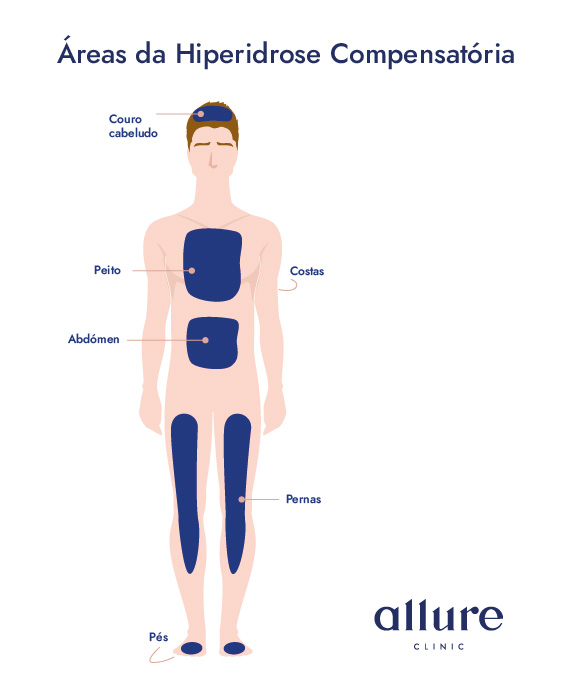
In which areas of the body does it occur most frequently?
You may feel a slight increase in sweating in untreated areas such as:
- Back;
- Chest;
- Abdomen;
- Legs;
- Scalp;
- Feet.
What is the treatment for Compensatory Hyperhidrosis?
Although there is a high risk of developing reflex hyperhidrosis during thoracic sympathectomy surgery, and since symptoms are often mild, most cases are treated with antiperspirants or oral medication. Oral medication may relieve symptoms in up to 70% of cases. There is no definitive treatment for compensatory hyperhidrosis.
Speak to a Specialist Doctor and find out which treatment is best.
If you suffer from excessive sweating and are looking for an effective solution, you should speak to a specialist doctor for a correct diagnosis.
At Allure Clinic we have several procedures to eliminate excess sweating in various areas of the body.
Talk to our medical team and find the best solution.
References:
Hyperhidrosis (2017) - https://www.mayoclinic.org/diseases-conditions/hyperhidrosis/diagnosis-treatment/drc-20367173
Hyperhidrosis Treatments - https://www.valleyhealth.com/services/hyperhidrosis-center/hyperhidrosis-treatments
ETS Surgery - https://www.valleyhealth.com/services/hyperhidrosis-center/hyperhidrosis-treatments/ets-surgery
Paliogiannis, P., Marrosu, A., Attene, F. et al. An unusual case of excessive sweating affecting the right upper limb after bilateral endoscopic thoracic sympathectomy for primary palmar hyperhidrosis: recurrence or compensatory hyperhidrosis?. Eur Surg 46, 169–172 (2014) - https://doi.org/10.1007/s10353-014-0275-7
Riet, M., Smet, A., Kuiken, H. et al. Prevention of compensatory hyperhidrosis after thoracoscopic sympathectomy for hyperhidrosis. Surg Endosc 15, 1159–1162 (2001) - https://doi.org/10.1007/s004640090097

Dr. Joana de Carvalho
- Graduated from the Faculty of Medicine of the University of Porto
- Specialist in Angiology and Vascular Surgery
- Fellow of the European Board of Vascular Surgery
- Member of the College of Phlebology
 English (UK)