

Treatment for Varicose Veins and Strokes can change your life
What treatments for varicose veins and strokes do you know?
There are brands that have the power to affect quality of life.
Among the most common are varicose veins and blood clots. Unfortunately, they don't go away on their own.
However, you don't have to accept living with these injuries – nowadays there are many treatments available, increasingly innovative and effective.
To find out which ones, continue reading.
Varicose Veins and Strokes – What’s the Difference?
It is relatively common to confuse the two concepts.
Let's clarify: Varicose veins are dilated veins that can become darker and more prominent over time; effusions are smaller vessels that, although located within the dermis, are evident due to their purplish or red hue.
In addition to appearance, they can manifest themselves through some symptoms, such as:
- Swelling in the legs/feet/ankles;
- Pain or discomfort;
- Cramps;
- Itching or tingling;
- Tiredness and feeling of tired legs.
Why do they appear?
Both varicose veins and effusions (also called telangiectasias) develop when the ability of veins to carry blood is damaged.
That is, healthy veins have valves that "push" blood back toward the heart. When they weaken and stop functioning properly, blood pools in the vein, causing continuous pressure that eventually causes it to swell.
They are very common in both sexes, but there seems to be a predominance in women., due to the hormonal changes that occur throughout life in different situations, such as a possible pregnancy.
There are other factors that appear to pose a greater risk, including:
- Excessive weight gain;
- Spending a lot of time standing or sitting;
- Little or no physical activity;
- Unhealthy eating habits;
- Family history.
The Importance of Treating Varicose Veins and Strokes
One of the most frequent complaints is related to aesthetic issues, and These marks can negatively affect self-image and confidence.
Unfortunately, in these cases, avoiding going to the beach or avoiding showing your legs, for example, are recurring situations that limit your quality of life more than desired.
However, the aesthetic component is often just the “tip of the iceberg” – These injuries may be the result of some health conditions that need to be resolved, not to mention the discomfort felt.
Furthermore, prolonging the problem can lead to other conditions, such as eczema, for example.
How to treat?
First, it is necessary to perform a patient assessment to outline the best therapeutic strategy.
Typically, the clinical history and the veins themselves are analyzed, using tests such as an ultrasound.
There are several treatment options that generally fall into two categories: surgical or minimally invasive.
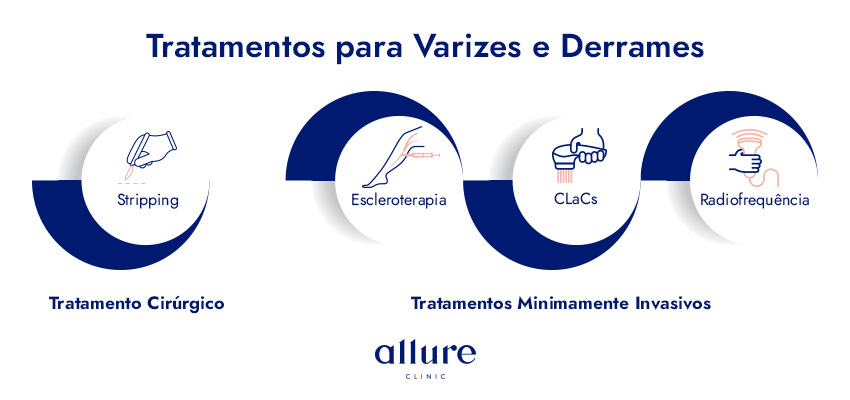
Surgical Treatment
1. Stripping
The first group includes techniques such as Stripping, where the saphenous vein is removed through an incision.
However, non-surgical treatments have been gaining ground, thanks to aspects such as:
- They do not require general anesthesia;
- They allow you to return to normal activities quickly;
- They require little post-treatment care (just wearing support stockings or avoiding sun exposure and exertion in some situations).
In fact, according to a 2019 study, patients treated with this type of procedure, which we will learn about next, see their quality of life improved and the clinical severity of the disease reduced.
Minimally Invasive Treatments
2. Sclerotherapy
Widely used in more superficial veins, Sclerotherapy consists of the injection of a solution (sclerosant) what promotes its collapse, forcing blood to redirect to healthier veins, where it is then naturally absorbed by the body.
This method can be performed with liquid, for effusions, or with foam, for large varicose veins.
What is more, It also allows you to treat the main veins that cause the problem.
It is a painless technique, lasting approximately 20/30 minutes per session, with the number of sessions depending on the area to be treated.
3.CLaCs (Cryo-Laser and Cryo-Sclerotherapy)
THE CLaCs is an innovative method, with fast results, used to treat strokes.
Combining laser with sclerotherapy, promotes the collapse of the vein and the consequent destruction of the diseased vessel.
The high technology used also allows us to identify invisible veins, which nourish and give rise to blood vessels, and which need to be treated.
The number of sessions depends on the number of veins to be treated.
It's a comfortable and non-aggressive method, so it can be recommended for most people.
4. Radiofrequency
Used in deeper veins, this technique transmits energy from radio frequency through a catheter inserted into the site that heats and contracts the vein, causing it to be reabsorbed and disappear over time.
It's a safe method, which does not harm the surrounding area.
Invest in your quality of life with trusted help
In addition to the treatment processes for varicose veins and strokes, which can be used simultaneously, some lifestyle changes (such as exercising or wearing compression stockings) combined with the experience of professionals can make a difference in maintaining healthy veins.
At Allure Clinic, we hope to help restore our patients' confidence through our experience in Vascular Surgery and personalized support.
Don’t put off taking care of yourself – make an appointment for varicose veins and strokes and confirm firsthand the recovery of quality of life.

Dr. Joana de Carvalho
- Graduated from the Faculty of Medicine of the University of Porto
- Specialist in Angiology and Vascular Surgery
- Fellow of the European Board of Vascular Surgery
- Member of the College of Phlebology
 English (UK)